
 Meet Dr. Botti
 Meet Dr. Scranton
 Our Team
 Patient Forms
 Online Bill Pay
 Benefit Program
 Your First Visit
Digital X-rays
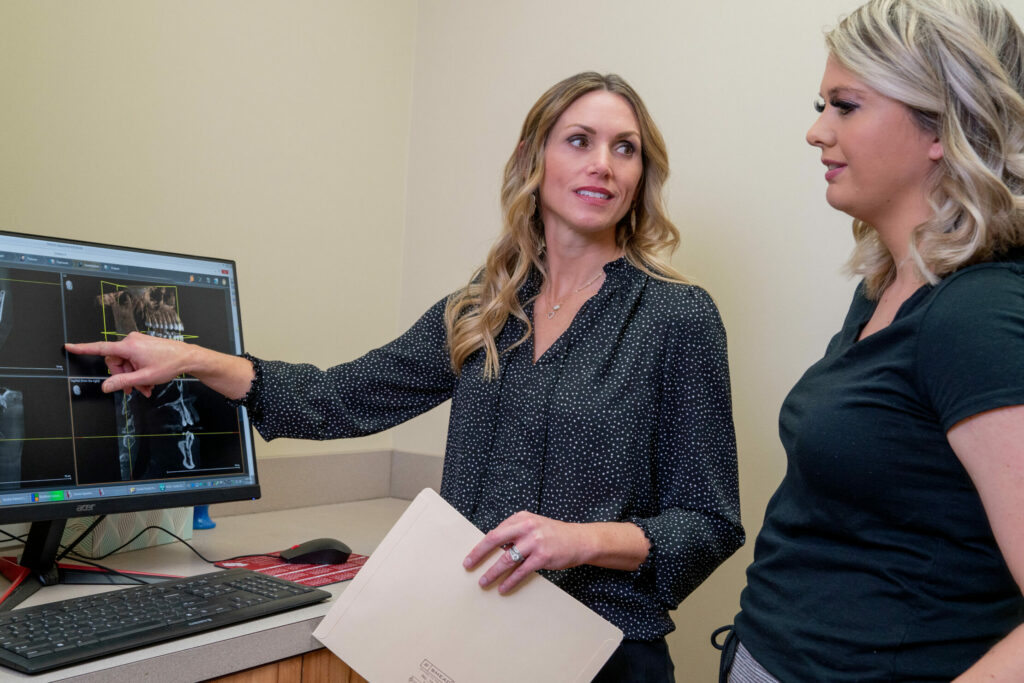
Digital X-rays, commonly called radiographs, are images of your teeth that we may take to evaluate your oral health. At South Dayton Smiles, many of our patients receive X-rays once per year. They allow us to look underneath the surface of the gums to make sure everything is healthy.
Anything hard or heavy, such as your teeth, will show up white on an X-ray. Then, anything light, such as air, will show up black. We use this information to help us interpret what we are seeing. Using X-rays to identify problems early on, we can prevent future problems from developing.
What Is Digital Radiography?
Digital radiography is a modern form of imaging used in dentistry and healthcare to capture detailed images of your mouth. Unlike traditional radiology methods that rely on photographic film and chemical processing, digital systems use advanced digital technology to create images instantly.
This type of medical imaging allows our team to view images of the body, including your tooth roots, jawbone, and soft tissues, with improved clarity. The images are displayed on a computer screen right away, which supports faster diagnosis and better patient care.
Digital X-ray systems use digital sensors or a flat panel detector instead of film cameras. These sensors capture detailed images and send them directly to a computer system for review. This process eliminates film development and allows for easy sharing between medical professionals and specialists.
The Types of Dental X-Rays
The exact information we collect on a dental X-ray will vary depending on the type of X-ray we take. Some of the most common types of dental X-rays include:
- Bitewing: We will ask you to bite on a small piece of paper or plastic. Then, we will take a look at the teeth above the gum line and the height of the bone between your teeth. This is important for helping us check between your teeth for cavities.
- Occlusal: This type of X-ray is typically taken on developing children and helps us see how the teeth are lined up in the upper or lower jaw.
- Panoramic: This is a two-dimensional X-ray that will show the entire mouth in one image. It helps us examine your soft tissue, your upper jaw, and your lower jaw.
- Periapical: This type of x-ray allows us to see a tooth from the root to crown with its surrounding bone structure.
We will talk with you about which types of X-rays we might take to help us take better care of your teeth.
What Might You See on an X-Ray?
We use dental X-rays as part of preventative and acute care. For example, we frequently take X-rays in children to ensure their teeth are developing appropriately. Regardless of age, there are several problems that we might spot.
For example, we use X-rays to make sure there is enough space for children’s teeth that are still developing. We can also use an X-ray to spot developing oral decay. As people get older, we will use X-rays to anticipate when wisdom teeth might emerge. That way, we might be able to respond earlier.
We can also use X-rays to identify decay underneath fillings. If you have prior cavities, they might be sealed with fillings, but cavities can still develop underneath the surface. We might not spot them without X-rays, so they are an important tool.
Digital radiography also helps detect fracture issues, arthritis in the jaw, and areas of decay that are not visible during a standard exam. These detailed images allow our team to monitor your dental health more closely.
Benefits of Digital X-Rays
Digital X-rays provide several advantages over traditional radiology methods.
Key benefits include:
- Less radiation compared to traditional X-rays
- Lower radiation exposure for safer imaging
- Immediate image preview on a computer screen
- Improved image quality and clarity
- No need for chemical processing or film development
- Easy sharing with other healthcare providers
Digital systems improve both efficiency and accuracy. They allow our team to identify problems early and create a more effective treatment plan.
How Digital X-Rays Support Better Dental Care
Digital imaging plays a major role in modern dentistry. It allows our team to diagnose issues earlier and provide more effective treatment.
These images help guide procedures such as root canal therapy, emergency care, and restorative treatments. They also help identify problems before they lead to further decay or the risk of infection.
By using digital systems, dental professionals can improve accuracy, reduce discomfort, and provide better overall patient care.
Common Questions About Digital X-Rays
Digital X-rays are considered very safe and use less radiation than traditional radiology methods. The level of radiation exposure is minimal and carefully controlled. Dental professionals follow strict safety guidelines to protect your body, and protective coverings may be used during imaging to further reduce risk.
The number of examinations you need depends on your oral health, age, and risk for dental problems. Some patients may need imaging once per year, while others may require more frequent monitoring. Our team will recommend a schedule that supports your long-term oral health and overall dental care.
Digital X-rays can detect cavities, areas of decay, fractures, and problems with tooth roots. They also allow our team to evaluate soft tissues, bone levels, and parts of your body that cannot be seen during a visual exam. This helps improve diagnosis and treatment planning.
Digital X-rays provide clearer images, faster results, and lower radiation exposure. They eliminate the need for film cameras, photographic film, and chemical processing. The immediate image preview and improved image quality make them a valuable tool in modern dentistry.
Patients choose South Dayton Smiles because we combine experience, personalized care, and advanced digital imaging technology to deliver accurate and efficient results. Our team focuses on making every visit comfortable while using modern tools to improve diagnosis and treatment.
Dr. Michele Botti and Dr. Jeri Scranton use digital X-ray technology to help detect problems early and create more precise treatment plans. By using advanced imaging, we can show you what is happening inside your mouth and help you feel more confident in your care. We take time to explain your results clearly so you can make informed decisions about your oral health. Our goal is to provide care that is accurate, comfortable, and tailored to your needs.
At South Dayton Smiles, our dentists are always happy to serve you in South Dayton. If you are ready to take a proactive approach to your dental health, our team is here to help. Digital X-rays allow us to detect problems early, create personalized treatment plans, and provide high-quality care tailored to your needs.
Call (937) 433-5133 today to schedule your appointment and experience the benefits of modern digital imaging for your smile.
Request an Appointment Today
At South Dayton Smiles, our dentists are always happy to serve you in South Dayton.
Testimonials
What Our Clients Say about Us
” Dr Botti has always been pleasant to work with, explaining details of the procedure as I had a crown replaced. “
– Mike G
” I LOVE Dr Botti and the staff at South Dayton Smiles. Michelle is my hygienist and I can’t wait for my appointments to have my teeth cleaned. “
– Debby M
” Everyone knows my name, knows my family, very personal touch. Everyone is great with my children. They treat us all like family. “
– Steve M
Associations and Memberships
proud to be a part of these organizations